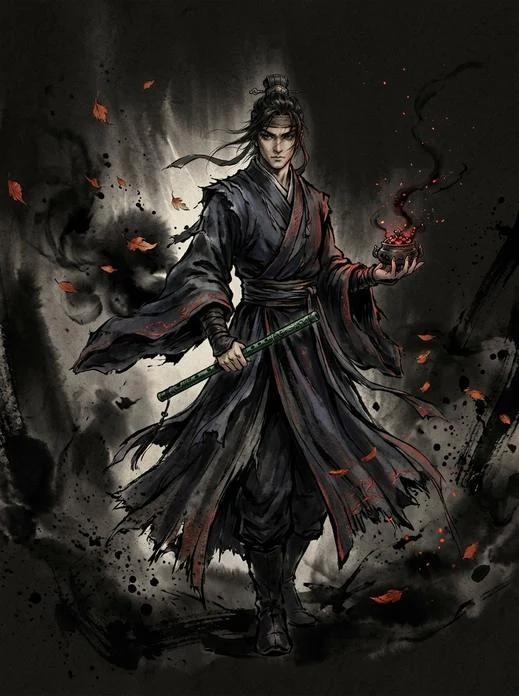
Practice and cultural meaning
Yin and yang have long intellectual histories in Chinese cosmology, divination and philosophical writing. Their paired qualities should be read through particular texts and practices rather than as two comic-book elements that cancel one another.
Regional and historical variation
A symbol on a modern fantasy costume may draw from recognisable diagrams while serving a new aesthetic function. The existence of a familiar symbol does not prove that the entire fictional energy system was an ancient doctrine. Interpretations and diagram histories differ by period.
What the image suggests
Ask what the pair organises in a given scene: motion and stillness, shade and light, authority and dissent? A film may use contrast beautifully without presenting a philosophical treatise. The atlas separates visual analogy from a documented proposition.
Why Extreme Yin Breeds Yang: Dual Blades, Dual Manuals, and Combat Polarity
Western fantasy habitually maps light and dark onto good and evil. Classical Chinese cosmology—from the I Ching (Book of Changes) and Laozi's Daodejing to traditional medicine—views Yin (阴: shade, cold, water, yielding, concealment) and Yang (阳: sun, heat, fire,剛猛 force, expansion) as interdependent poles of a single dynamic whole. Neither can exist alone, and each contains the seed of the other.
In wuxia combat design, Yin and Yang govern both internal cultivation and weapon pairing. A fighter who cultivates only scorching Yang Qi (such as the Nine-Yang Divine Skill) risks burning up their own meridians unless balanced by cooling stillness; a fighter struck by freezing Yin palm poison (like the Xuanming Divine Palm) can only be saved by pure Yang infusion.
Similarly, twin weapons and paired artifacts—such as Twin Swords (Zimujian, 子母剑, Mother-and-Child Blades) or dual Puppet Eyes—require the wielder to alternate between heavy, direct Yang strikes and elusive, deceptive Yin feints.
⚔️ Why It Matters in Phantom Blade Zero & Where Winds Meet: Crystal Puppet Eye [Yang/Yin] & Red/Blue Attack Polarity in PBZ
In Phantom Blade Zero, exploring the base of Crimson Manor beneath the Sha-Chi tower yields the crucial Crystal Puppet Eye [Yang] relic needed for the True Ending, while combat itself is built around dual polarity: Blue Brutal Moves must be parried head-on (Yang), whereas Red Killer Moves must be Ghoststepped into shadow (Yin).
Primary Sources & Further Reading
- Stanford Encyclopedia of Philosophy — Laozi ↗
- Chinese Text Project — Zhuangzi ↗
- Stanford Encyclopedia of Philosophy — Metaphysics in Chinese Philosophy ↗
- S-GAME — Phantom Blade Zero on Steam ↗