Practice and cultural meaning
Chinese opera traditions have developed many distinct kinds of painted faces, masks, costume rules and stage movement. A single famous face pattern is not a uniform code for every theatre or historical period. Individual forms require named evidence.
Regional and historical variation
Wuxia cinema borrows stylisation from performance traditions: a sudden entrance, an emphatic stance or a colourful sign of character. A modern game may remix those shapes into a boss design. The lineage of influence should be established by creator statements or close documented comparison, not assumed from visual resemblance alone.
What the image suggests
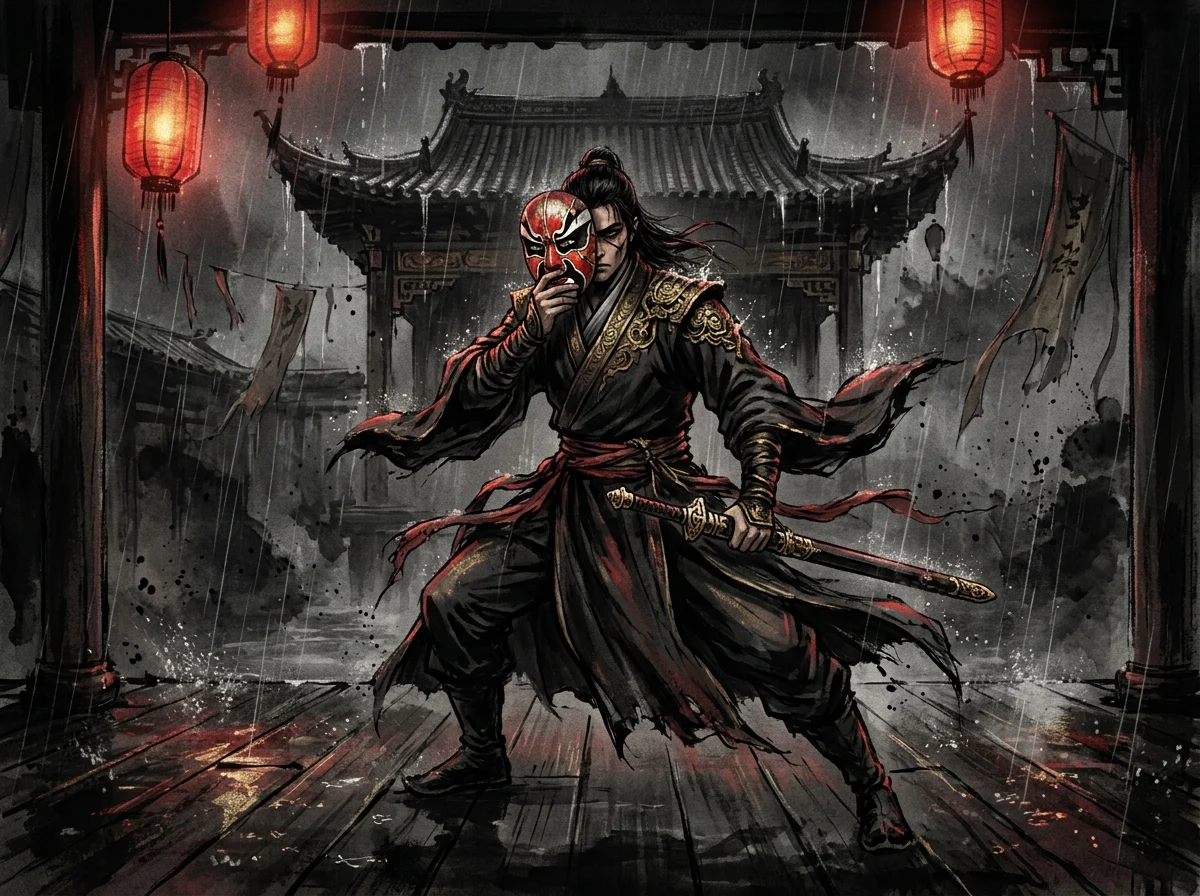
A mask can signify disguise, social role, transformation or terror depending on the work. Reading it responsibly begins by identifying which performance tradition or film is actually being referenced before assigning a fixed moral colour.
When the Opera Drum Sounds, the Assassin Steps onto the Stage
Chinese martial arts and traditional Chinese opera (Xiqu, 戏曲—including Peking Opera, Kunqu, and regional Sichuan/Cantonese operas) grew up under the same roof. For centuries, opera troupes traveled by riverboat from town to town, training performers in acrobatics, spear-kicking, and stage swordplay—which is why historical authorities often suspected travelling opera boats of harboring rebels and assassins.
On the opera stage, Lianpu (脸谱, painted face patterns) act as an instant moral code: cinnabar red (like Guan Yu) signals fierce loyalty; stark chalk-white signals cunning treachery; black signals blunt incorruptibility; and gold/silver marks gods and spirits. Sichuan Opera adds Bianlian (变脸, Face-Changing)—snapping from one silk mask to another in a fraction of a second with the sweep of a fan.
Wuxia darkens this theatricality into two haunting motifs: ritual Acolyte Masks worn by cult executioners to erase their human past, and Yirongshu (易容术, Disguise Art)—where master artisans sculpt lifelike flesh masks to infiltrate enemy strongholds.
⚔️ Why It Matters in Phantom Blade Zero & Where Winds Meet: The Four Acolyte Masks in PBZ & Masked Troupe / Disguise in WWM
In Phantom Blade Zero, hunting down hidden scarecrow/acolyte bosses across the Village of Lu, Crimson Manor, and Meigu Lake to collect all Four Acolyte Masks is the key to unlocking the secret Discordance Realm on the frozen shoal! Meanwhile, in Where Winds Meet, Disguise (画皮易容) is a core profession and the signature art of Nine Mortal Ways and The Masked Troupe.