Practice and cultural meaning
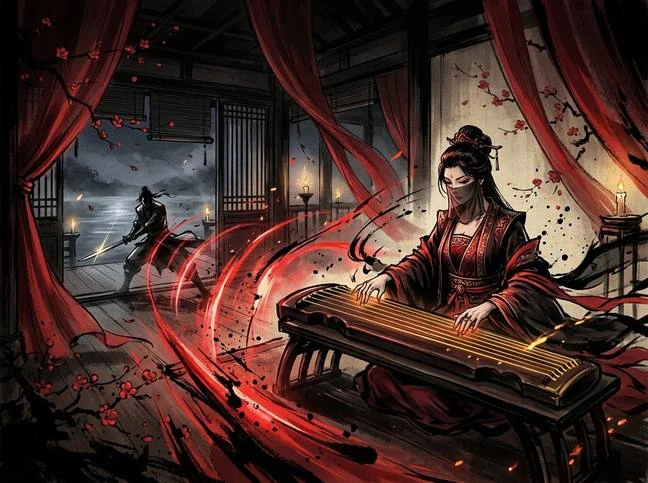
Guqin is a plucked zither associated with scholarly and artistic traditions. UNESCO records its cultural significance, performance contexts and transmission. In wuxia, a guqin can establish atmosphere, articulate restraint or conceal conflict through sound and silence.
Regional and historical variation
A cinematic instrument cue should not be assumed to reproduce the music of a stated historical period. Tunings, techniques and works each carry histories; contemporary sound design frequently combines instruments and electronic processing. A digital sine wave is not a recorded guqin.
What the image suggests
Listening to the five pentatonic tones—Gong, Shang, Jue, Zhi, and Yu—reveals how Chinese musical intervals evoke stillness, gathering storm, and the clash of blades.
Seven Silk Strings, Five Pentatonic Tones, and the Deadly Melody
For over three thousand years, the Guqin (古琴, seven-stringed fretless zither) has stood at the summit of Chinese literati culture—the first of the Four Arts of the Scholar (Qin, Qi, Shu, Hua: Zither, Go, Calligraphy, Painting). Tuned to the Chinese pentatonic scale—Gong (宫), Shang (商), Jue (角), Zhi (徵), and Yu (羽)—a Guqin is played in quiet pavilions to harmonize the mind with flowing rivers and pine winds.
In the famous tale of Boya and Ziqi, master musician Yu Boya smashed his Guqin after his friend Zhong Ziqi died, because no one else in the world could hear the mountains and rivers inside his strings—giving birth to the word Zhiyin (知音, 'one who knows my sound,' a true soulmate).
Wuxia imagination flipped this refined instrument into two unforgettable tropes: the transcendent duet of 'Smiling, Proud in the Jianghu' (Xiaoao Jianghu) shared across faction lines, and the terrifying 'Sonic Assassination' (Yinlv Shaji)—where a master channels internal Qi or Sha-Chi into iron-silk strings (as in Deadly Melody or Kung Fu Hustle) to fire invisible acoustic shockwaves that shatter swords and rupture hearts.
⚔️ Why It Matters in Phantom Blade Zero & Where Winds Meet: The Illusory Pipa Quest & Playable 5-Tone Guqin Dojo
In Phantom Blade Zero, restoring the three broken pieces of the Illusory Pipa (幻音琵琶) for Myst at Pangzhen tavern and defeating the boss at the Collapsed Theater on Meigu Lake unlocks the Illusory Pipa Phantom Edge—letting Soul fire acoustic Sha-Chi shockwaves! You can pluck all 5 pentatonic strings yourself in our Interactive 5-Tone Guqin Zither Dojo.