Literary origins and the screen
Female knights-errant have substantial lives in Chinese martial literature and cinema. Their roles cannot be reduced to a recent adjustment of a supposedly exclusively male genre. King Hu's Come Drink with Me and A Touch of Zen make women consequential agents whose actions drive the plot.
The work of interpretation
Stephen Teo highlights the xianü, or female knight-errant, in his film scholarship. Each work nevertheless has its own politics of gender, desire and authority. A woman fighter's presence does not guarantee that the narrative gives her freedom to define her commitments.
Watch with a question
When comparing two heroines, ask whether each is allowed to refuse an oath, leave a master, or choose whom to help. Those decisions reveal more than a costume or a count of sword strikes. Historical gender restrictions also vary by period and must not be imposed as a universal game rule.
From Tang Dynasty Assassin Nie Yinniang to Golden Swallow and Jade Fox
One of the most striking features of Chinese wuxia compared to Western medieval chivalry is the centrality and authority of the Nüxia (女侠, Female Knight-Errant). Because wuxia prowess depends on internal Qi, lightness (Qinggong), acupoint precision, and weapon finesse rather than raw body weight, women in the Jianghu have fought as equals—and often superiors—to men for over a millennium.
The literary lineage begins in Tang dynasty Chuanqi tales such as Nie Yinniang (聂隐娘, The Assassin) and Hongxian (红线), where female martial artists move invisibly over rooftops to deter warlords without starting wars. In the 20th century, Cheng Pei-pei's Golden Swallow in Come Drink with Me, Hsu Feng in A Touch of Zen, Brigitte Lin's Dongfang Bubai, Michelle Yeoh, and Zhang Ziyi cemented the Nüxia as global icons.
In wuxia worldbuilding, entire powerhouse factions—such as the Emei Sect, Misty Palace, or Velvet Shade—are led by female grandmasters whose martial codes challenge both imperial patriarchy and orthodox sect hypocrisy.
⚔️ Why It Matters in Phantom Blade Zero & Where Winds Meet: Female Bosses, Myst & Umbrella/Fan Assassins in PBZ & WWM
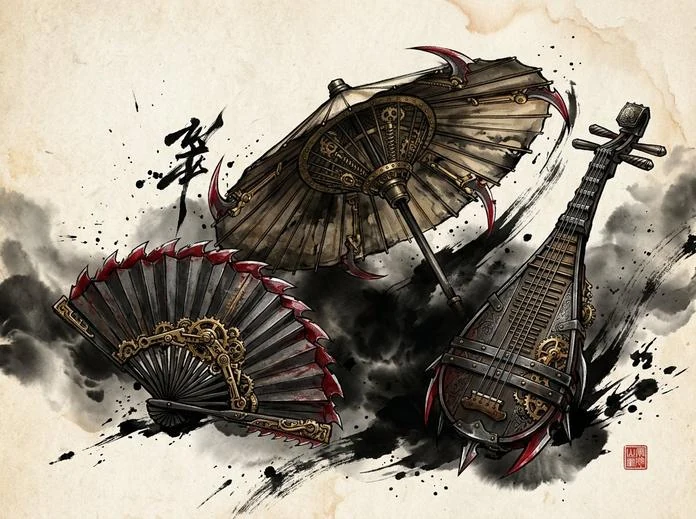
From enigmatic tavern lute-master Myst and lethal female bosses in Phantom Blade Zero to the Soulshade Umbrella and Panacea Fan matriarchs of Hollow Vale and Velvet Shade in Where Winds Meet, the Nüxia tradition defines some of the most stylish combat builds in modern dark wuxia.
Primary Sources & Further Reading
- British Film Institute — Where to Begin with King Hu ↗
- Stephen Teo — Chinese Martial Arts Cinema: The Wuxia Tradition (2009) ↗
- Hong Kong Film Archive — Come Drink with Me (1966) ↗
- S-GAME — Phantom Blade Zero on Steam ↗