Literary origins and the screen
Jin Yong and Gu Long reshaped modern popular expectations of wuxia through distinct approaches to character, suspense and social worlds. Jin Yong's fiction often develops broad networks of allegiance and inherited history. Gu Long's fiction is frequently associated with compressed dialogue, mystery and unusual heroes.
The work of interpretation
Both writers are modern authors whose texts remain copyrighted. A cultural reference guide can analyse common motifs and provide bibliographic pathways without reproducing their prose, illustrations or branded character portraits. Exact publication histories and translations should be checked edition by edition.
Watch with a question
Compare the kind of information a reader is allowed to have. A densely mapped lineage builds one kind of suspense; an unfamiliar room and an evasive conversation build another. Neither effect can be reduced to a martial power scale.
The Two Pillars of Modern Wuxia: Epic Symphony vs. Hardboiled Jianghu Noir
To understand modern wuxia, you must meet its two literary titans: Jin Yong (Louis Cha, 1924–2018) and Gu Long (Xiong Yaohua, 1938–1985). Jin Yong—author of the Condor Trilogy, Demi-Gods and Semi-Devils, and The Smiling, Proud Wanderer—wrote panoramic historical epics. His heroes begin as clumsy or misunderstood youths who endure decades of training, absorb classical Buddhist/Daoist wisdom, and defend besieged cities against invading armies.
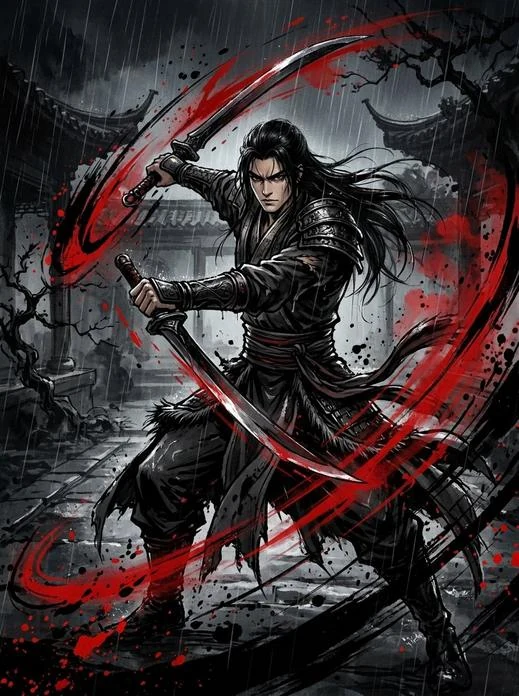
Gu Long—author of Meteor, Butterfly, Sword (流星·蝴蝶·剑), Chu Liuxiang, Lu Xiaofeng, and Little Li's Flying Dagger—broke every rule Jin Yong established. Influenced by Western hardboiled detective noir, Ernest Hemingway, and Japanese samurai fiction, Gu Long wrote in short, staccato, poetic paragraphs. His heroes do not spend ten chapters learning a manual; they are already lethal masters when page one opens—coughing blood in a rainy tavern, drinking cheap wine to numb an old heartbreak.
In a Gu Long duel, there are no three-hundred-move exchanges: two masters stand in silence as autumn leaves fall, a single flash of steel rings out, and one man is already dead.
⚔️ Why It Matters in Phantom Blade Zero & Where Winds Meet: Why Gu Long Is the Spiritual Father of Phantom Blade Zero
While open-world games like Where Winds Meet draw heavily from Jin Yong's historical Song Dynasty epics, Phantom Blade Zero is 100% pure Gu Long DNA. Soul's stoic loneliness, the rain-drenched assassin syndicate (echoing Gu Long's Meteor, Butterfly, Sword), and the fatalistic beauty of fighting on borrowed time come straight from Gu Long's noir Jianghu.
Primary Sources & Further Reading
- Stephen Teo — Chinese Martial Arts Cinema: The Wuxia Tradition (2009) ↗
- Tsinghua University — A Stylistic Analysis for the Fictions Written by Jin Yong and Gu Long ↗
- S-GAME — Phantom Blade Zero on Steam ↗