Literary origins and the screen
Late-1920s Shanghai cinema helped establish screen wuxia as a popular serial form. Its development involved novels, commercial distribution, changing technology and government restrictions, not simply a linear improvement in stunt technique. Stephen Teo documents this early phase and the later Hong Kong and Taiwan traditions.
The work of interpretation
Swordplay films transformed what prose asked readers to imagine into actions that audiences could follow through cuts, props, camera placement and performers. Some screen conventions now feel ancient because they have been repeated for generations. They are modern audiovisual grammar.
Watch with a question
A production date, a release title and a surviving print can be researched separately. This matters when early films are incomplete or lost. Rather than invent clips, this atlas points readers toward film archives and scholarship and keeps its demonstrations as original schematic frames.
Shanghai Silent Serials, Shaw Brothers Steel, and Tsui Hark's Wirework Revolution
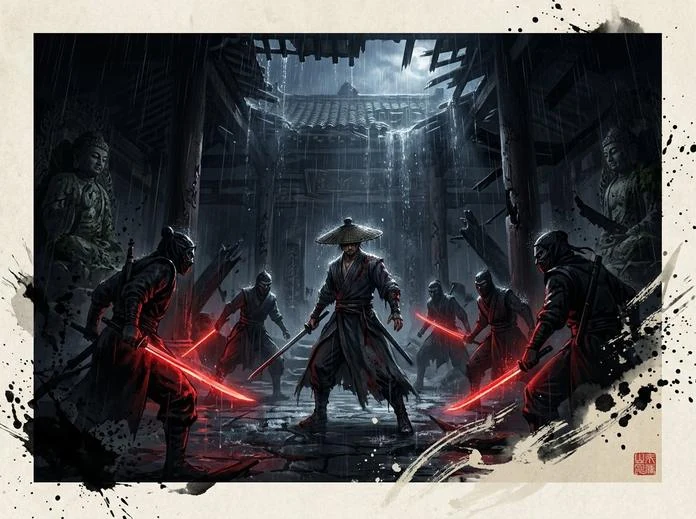
Every time you see a warrior silhouette framed against a paper screen or a rain-soaked temple courtyard in a video game, you are looking at a century of Chinese cinema evolution. It began in 1928 Shanghai with director Zhang Shichuan's silent blockbuster The Burning of the Red Lotus Temple (火烧红莲寺), which sparked an eighteen-part serial craze and pioneered early wire-suspension and hand-tinted sword-light effects.
In the mid-1960s, Hong Kong's Shaw Brothers Studio launched the 'New School Wuxia' (新派武侠) movement, rejecting stiff theatrical staging in favor of visceral realism, rapid editing, and moral ambiguity. Chang Cheh's One-Armed Swordsman (1967) drenched the screen in heroic bloodshed (Heroic Bloodshed / Yanggang), while King Hu brought poetic spatial choreography.
In the late 1970s through the 1990s, Chor Yuen adapted Gu Long's misty gothic murder mysteries, and Tsui Hark (Swordsman II, New Dragon Gate Inn) accelerated wuxia editing to lightning speed—directly inspiring the kinetic camera and combo rhythm of 2020s Chinese action RPGs.
⚔️ Why It Matters in Phantom Blade Zero & Where Winds Meet: 1970s–90s Hong Kong Cinema Reborn in Unreal Engine 5
Producer Soulframe Liang explicitly designed Phantom Blade Zero to feel like playing inside a Golden Age Hong Kong martial arts film—complete with dynamic camera zoom-cuts on parries, rain-splattered lanterns, and boss intros that echo Tsui Hark's The Blade (刀, 1995) and Chor Yuen's Gu Long adaptations.
Primary Sources & Further Reading
- Stephen Teo — Chinese Martial Arts Cinema: The Wuxia Tradition (2009) ↗
- British Film Institute — Ten Great Wuxia Swordplay Films ↗
- S-GAME — Phantom Blade Zero on Steam ↗