Practice and cultural meaning
Lion dance has distinctive regional practices that unite movement, music, communal occasion and physical coordination. Its association with martial training or a festival setting depends on the particular tradition and historical evidence.
Regional and historical variation
Film choreography can draw on the timing of a lion's head, the movements of paired performers and the changes in rhythmic accompaniment. That borrowing does not make every lion-dance sequence a battle technique. Performance and combat organise bodies toward different ends.
What the image suggests
Observe what makes a motion legible to a crowd. The lion may pause, acknowledge an onlooker or react to an imagined obstacle. A game animation can learn from these expressive beats while remaining clear that its fictional character or skill is a new creation.
High-Pole Plum Blossom Piles, Festival Drums, and the Brass Lion's Roar
In southern China—especially Guangdong and Foshan, the historical cradle of Wong Fei-hung, Hung Gar, Choy Li Fut, and Wing Chun—almost every traditional martial arts hall (Wuguan, 武馆) maintains its own Lion Dance team (Xingshi, 醒狮, the 'Awakening Lion'). Far from a gentle parade dance, performing inside the heavy lacquered rattan-and-brass lion head requires ferocious lower-body endurance (Zhamabu, horse stance) and partner synchronization.
During rival school encounters or festival competitions (Caiqing, 'plucking the greens' hung stories high above the street), two martial artists leap across Meihuazhuang (梅花桩, elevated iron-and-timber Plum Blossom Poles) while war drums thunder below. As Tsui Hark immortalized in Once Upon a Time in China III, a lion dance between rival factions is a full-contact martial duel disguised as celebration.
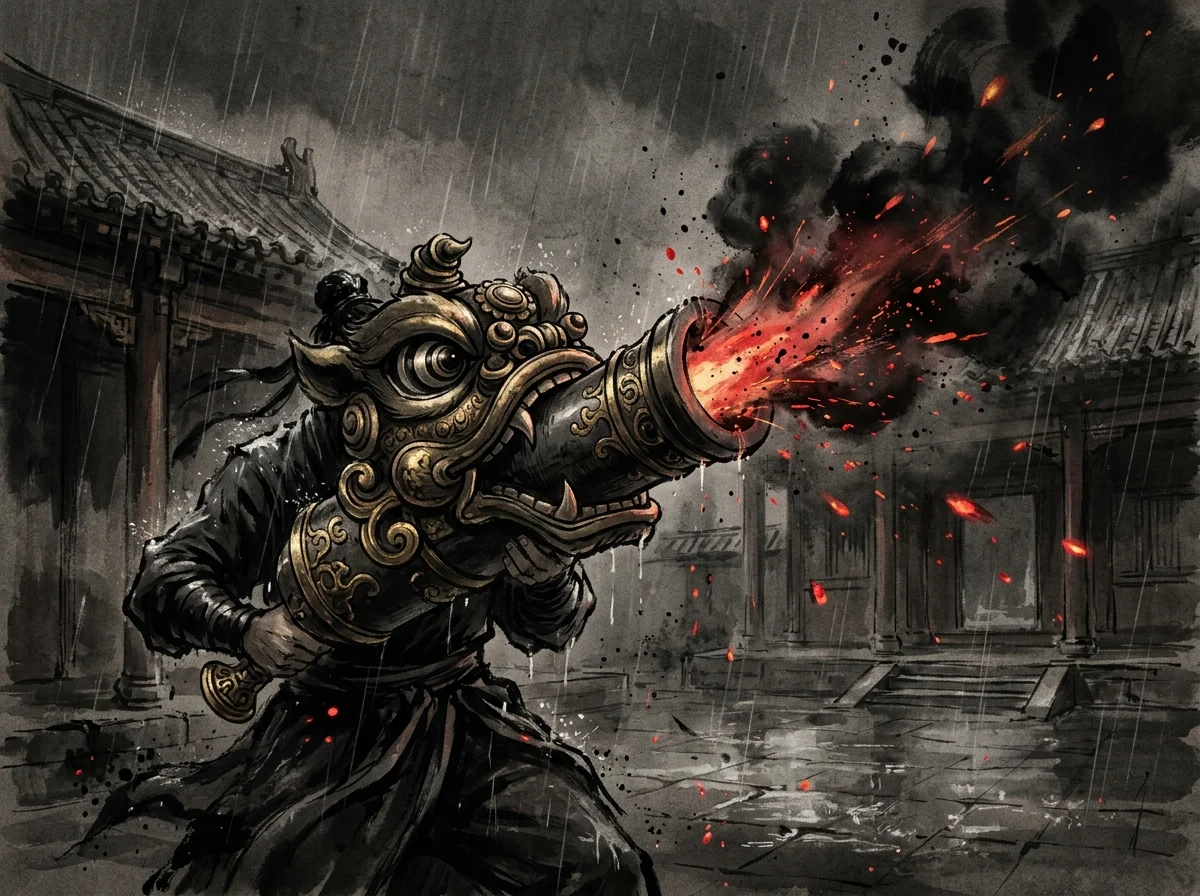
Modern dark wuxia takes the fierce geometry of the Cantonese Awakening Lion—its glaring brass eyes, horned brow, and hinged jaws—and fuses it with gunpowder and Sha-Chi artillery.
⚔️ Why It Matters in Phantom Blade Zero & Where Winds Meet: The Iconic Wake-Lion Fire Cannon (醒狮火铳) in Phantom Blade Zero
One of the most jaw-dropping signature Phantom Edges in Phantom Blade Zero is the Lion-Head Fire Cannon (醒狮火铳 / Tiger-Lion Hand Cannon): a heavy brass-and-iron Cantonese Awakening Lion head worn over Soul's arm that belches crimson Sha-Chi flames and explosive cannonballs to stagger armored bosses and clear entire courtyards!