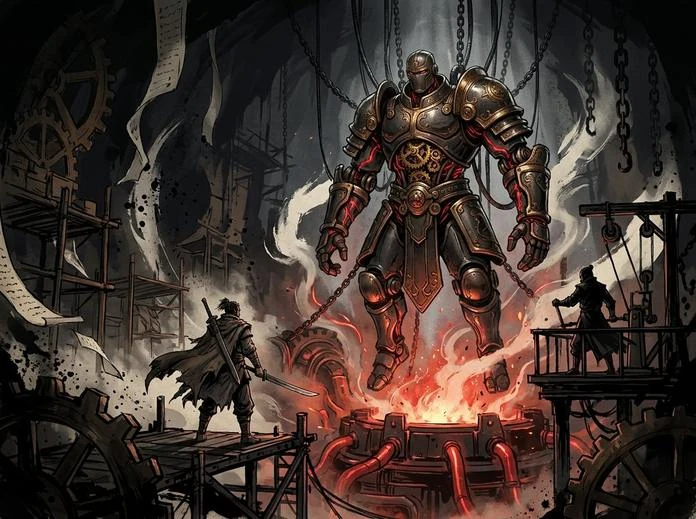
Modern design vocabulary
Fantastical engineering offers wuxia games a way to stage machines, weapons and architectural surprises that do not belong to real technical history. An impossible device can still express a credible feeling: fear of siege, pride in craft or anxiety about unchecked power.
From inherited image to new medium
The Mozi contains textual material on defense and discussions of useful techniques. That corpus should be read in its historical context. It does not license arbitrary claims that all elaborate game mechanisms have been found in ancient Chinese ruins.
Comparison without confusion
In wuxia worldbuilding, mechanical contraptions test both a hero's spatial awareness and the moral responsibility of the artisan who forged them.
Mohist Artisans, Wooden Automatons, and the Clockwork Sanctum
Long before modern steampunk, Chinese historical texts—such as the Warring States philosophical compilation Mozi (墨子) and the Daoist classic Liezi—celebrated the figure of the master artisan-engineer. The Mohists (Mojia, 墨家) were an organized fraternity of warrior-engineers who preached 'Universal Love and Non-Aggression' (Jian'ai Feigong) and traveled to besieged cities to build ingenious counterweight ladders, torsion catapults, and subterranean listening tunnels.
Meanwhile, the Liezi tells the famous story of Yan Shi (偃师), an artificer who presented King Mu of Zhou with a life-sized mechanical automaton constructed of leather, wood, resin, and painted organs that could sing and dance with human precision.
Wuxia literature (from Jin Yong's Peach Blossom Island formations to Qin's Moon and modern Kungfupunk) expanded Jiguan (机关, 'Mechanical Contraptions') into underground labyrinths of shifting stone walls, bronze dragon gear-gates, and transforming multi-form weapons.
⚔️ Why It Matters in Phantom Blade Zero & Where Winds Meet: Mohist Hill Sect, Three-Eyed Puppets & Pangzhen Foundry
In Phantom Blade Zero, interacting with the Three-Eyed Puppet portals across the Village of Lu, Mandate's Encampment, and Mountain of Imprisonment—and using the Puppet's Tongue to unlock Crimson Manor—is essential to uncovering the game's true mechanical conspiracy. In Where Winds Meet, you can join the Mohist Hill Sect (墨山道) to master invention and siege engineering.
Primary Sources & Further Reading
- Chinese Text Project — Mozi ↗
- Stanford Encyclopedia of Philosophy — Mohism ↗
- S-GAME — Phantom Blade Zero on Steam ↗