Practice and cultural meaning
Brush writing has long served administration, scholarship and artistic expression. A character's hand can be judged as carefully in an examination of a text as a warrior's movement is judged in a duel. But cinematic analogies between calligraphy and fighting should not be presented as a literal historical training method without proof.
Regional and historical variation
Ink washes and the use of negative space offer filmmakers and illustrators ways to imply fog, distance and motion. The expressive vocabulary is broad and changing; it does not belong to a single imaginary dynasty.
What the image suggests
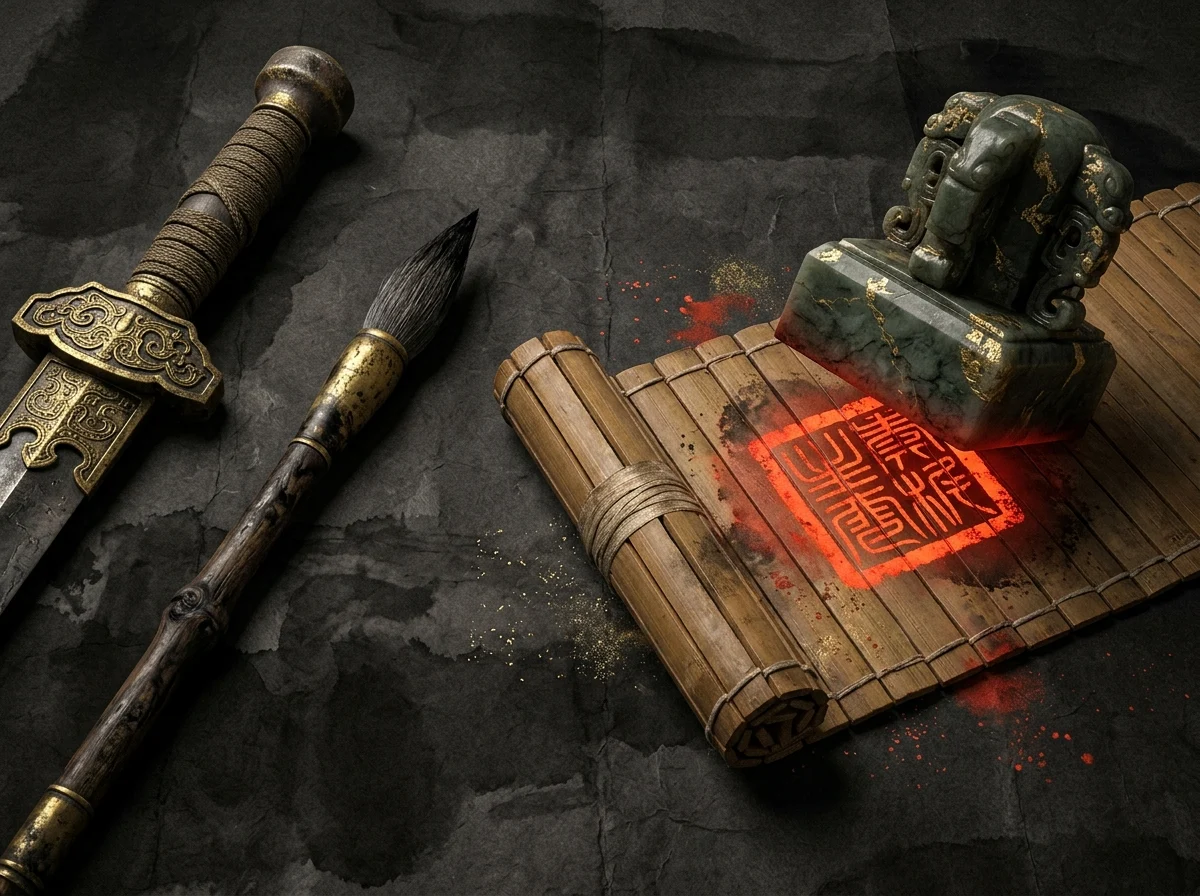
Traditional bookmaking—with its crimson cinnabar seals, vertical columns, and absorbent Xuan paper margins—carries the visual rhythm of the martial world into every scroll.
Why Sword Intent (Jianyi) Is Written in Ink and Cinnabar
Chinese culture has long celebrated the ideal of Wenwu Shuangquan (文武双全)—the warrior-scholar who masters both the brush (Wen) and the blade (Wu). During the Tang dynasty, the legendary calligrapher Zhang Xu reportedly unlocked the wild, unbroken rhythm of his 'Crazy Cursive' (Kuangcao) script after watching Lady Gongsun perform the flashing Sword Dance.
Look closely at a stroke of traditional Chinese ink-wash painting (Shuimo, 水墨) on absorbent Xuan paper and you will see the exact physics of a wuxia duel: where the brush pauses and presses down, dark ink pools like gathered internal Qi; where the wrist whips across the paper at lightning speed, the bristles split to leave streaks of untouched white paper—a technique called Feibai (飞白, 'Flying White') that mirrors the sonic trail of a blade slicing through rain.
In wuxia fiction (such as Jin Yong's Heaven Sword and Dragon Saber, where Zhang Cuishan carves twenty-four iron-hook characters into a cliff face using a判官笔, Judge's Iron Brush), calligraphy is literally a combat art.
⚔️ Why It Matters in Phantom Blade Zero & Where Winds Meet: Dark Sumi-e Aesthetics & The Inkbound Order
Both Phantom Blade Zero's UI/boss intros and this Atlas are built on Dark Ink-Wash (Sumi-e) + Vermilion Cinnabar aesthetics—where flying-white ink strokes trace every blade arc. In Where Winds Meet, the scholarly Inkbound Order (文津馆) sect weaponizes brush, scroll, and classical law directly in combat.