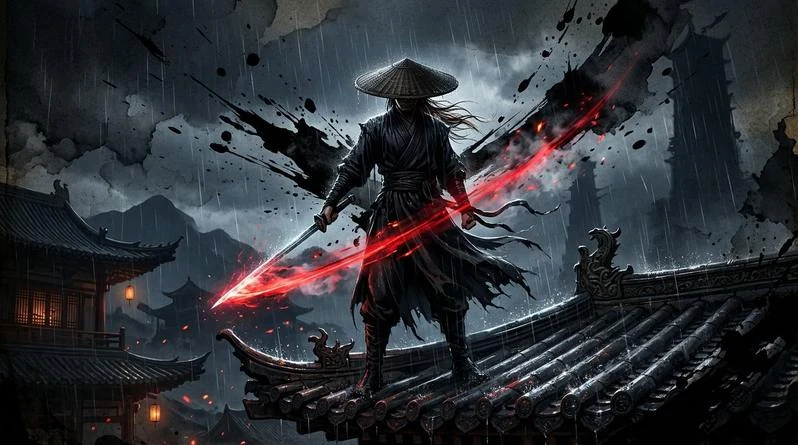
Meaning and historical frame
The ordinary words jiang and hu mean rivers and lakes. Together they came to suggest a world of travel, personal obligation, risk and reputation apart from the formal centre of power. In a wuxia story it may include porters, innkeepers, fugitives, performers, merchants and fighters; it is not a hidden territory with a fixed historical border.
How the term travels
A jianghu plot needs routes as much as weapons. A traveller carries messages between people who may never enter the same room. Rumour travels faster than proof, and being known by the wrong name can close a door. These mechanics make a tea house or ferry crossing dramatically important.
Read it in a scene
Ask what being outside an office or a court permits, and what it costs. The world of rivers and lakes is often imagined through the eyes of people without secure access to official protection. It is a literary social space, not evidence that all early Chinese societies shared one independent underworld.
Why 'Rivers and Lakes' Became China's Underworld of Outlaws and Heroes
Translate jianghu word for word and you get 'rivers and lakes.' Read it inside Chinese cultural memory and an entire parallel society opens before you. In early Daoist classics such as the Zhuangzi and poems by Song dynasty exiles, 'rivers and lakes' meant retreating from the suffocating rituals of the imperial court (miaotang, 庙堂) into untamed nature. Over centuries of vernacular storytelling—culminating in Water Margin (Shuihu Zhuan) and 20th-century martial fiction—that wilderness evolved into a living social ecosystem.
The Jianghu exists wherever imperial magistrates cannot easily enforce their writs: ferry crossings at dusk, mountain passes, roadside wine shops, escort-agency routes, and hidden sect compounds. Its citizens include righteous knights-errant, disgraced officials, travelling physicians, boatmen, poison alchemists, and contract killers. Because state courts do not arbitrate disputes here, reputation (mingsheng), secret hand signs, and the blade settle every contract.
As the famous wuxia proverb warns: 'Once you step into the Jianghu, your life is no longer your own' (人在江湖,身不由己). Every favor accepted creates a debt; every duel won creates a blood feud among the loser's disciples. The Jianghu is at once a refuge of radical personal freedom and a web of inescapable human entanglement.
⚔️ Why It Matters in Phantom Blade Zero & Where Winds Meet: Navigating the Phantom World & Ten Kingdoms Jianghu
When Western players enter Phantom Blade Zero's dark regions—like the rain-lashed alleys of Pangzhen, the eerie Village of Lu, or the mist-shrouded islands of Meigu Lake—they are walking through a quintessential dark Jianghu where imperial authority has vanished and clandestine syndicates rule. In Where Winds Meet, the Jianghu is simulated as an interactive social fabric where bumping into a beggar at a teahouse can trigger a sect initiation or a stolen martial manual.
Primary Sources & Further Reading
- Chinese Text Project — Shiji, Youxia liezhuan ↗
- Stephen Teo — Chinese Martial Arts Cinema: The Wuxia Tradition (2009) ↗
- S-GAME — Phantom Blade Zero on Steam ↗