Relationships and obligations
The Chinese word menpai can refer to a school or faction in literary and modern usage, but its boundaries are not fixed across history. Some schools refer to documented people and pedagogies; others exist only in novels, theatre or games. A Daoist religious community is not automatically a martial school, and a philosophical tradition is not a membership guild.
Evidence for the practice
When a fictional sect has an entrance examination, uniform, martial techniques and rank, those rules belong to its author unless independent documentation establishes a parallel practice. Real martial lineages vary by place and generation. Labels that later became famous may have changed meaning.
Read the consequences
The atlas uses seven organisation types rather than a single sect category. This avoids listing the Mohists beside a fantasy mountain clan as though both had identical historic status. A game can still learn immersion from duties, routines and mutual dependence without copying another studio's proprietary sects.
Orthodox Summits, Unorthodox Valleys, and Shadow Syndicates
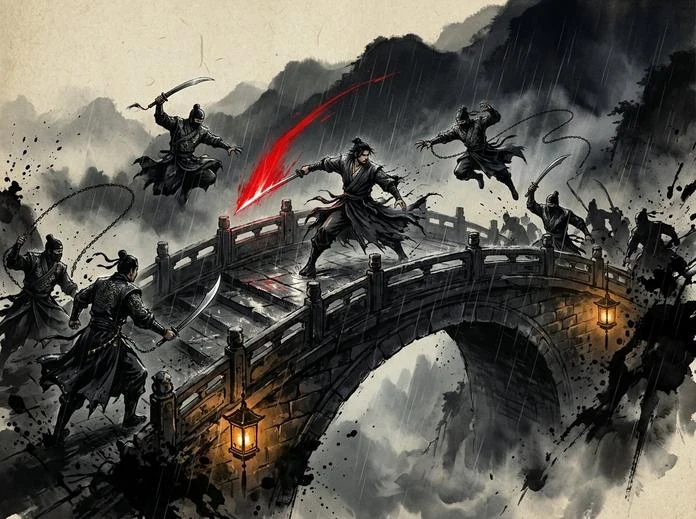
In wuxia worldbuilding, the landscape of China is mapped not by provincial governors, but by mountain peaks and hidden valleys controlled by great Menpai (门派, 'gates and tributaries'). Historically, martial styles clustered around regional clans, military garrisons, or religious mountains such as Songshan Shaolin (Buddhist staff and fist) and Wudang Mountain (Daoist internal swordplay).
Wuxia novelists expanded this into a rich geopolitical chessboard. Traditional lore groups them into Three Alignments: the Righteous/Orthodox Sects (Zhengpai—Shaolin, Wudang, Emei, Beggar's Sect, Mount Hua), the Neutral/Deadly Clans & Specialist Guilds (such as the Sichuan Tang Clan of poisons and mechanical darts, or the Mohist engineers), and the Unorthodox or Demonic Cults (Xiepai / Mojiao) who reject Confucian hypocrisy in favor of raw passion or forbidden cultivation.
Joining a sect grants shelter, status, and access to guarded manuals—but demands strict obedience to Sect Precepts (mengui). Breaking a precept invokes the Law-Enforcement Hall's blades.
⚔️ Why It Matters in Phantom Blade Zero & Where Winds Meet: The 12 Sects of Where Winds Meet & Factions of Phantom Blade Zero
In Where Winds Meet, your choice among 12 distinct sects reshapes your gameplay rules: Silver Needle healers must demand payment and likes from patients; Hollow Vale poison-doctors must use venom for every life saved; Nine Mortal Ways pranksters thrive on disguise and Rope Darts; and Midnight Blades lose karma if they show mercy in PvP. You can test which of the 12 Sects fits your soul in our 66-Day RPG & Soul Quiz.
Primary Sources & Further Reading
- UNESCO — Taijiquan ↗
- Stanford Encyclopedia of Philosophy — Laozi ↗
- Stanford Encyclopedia of Philosophy — Mohism ↗
- S-GAME — Phantom Blade Zero on Steam ↗