Meaning and historical frame
Wuxia joins wu, the martial, to xia, a figure who may act outside ordinary authority to honour a debt or defend another person. The English phrase martial chivalry helps, but a knight in medieval Europe and a xia in Chinese writing did not occupy the same social world. Follow the question of whom a fighter believes they owe.
How the term travels
Sima Qian’s Shiji devotes biographies to wandering knights, but those early accounts are not already modern wuxia novels. Twentieth-century fiction and cinema transform inherited stories into elaborate worlds of masters, rival factions, hidden loyalties and extraordinary bodies. A film may borrow an ancient term while inventing its rules.
Read it in a scene
In an action game, every sword fight can seem like a test of skill. A wuxia story also asks what obligation made the character draw the sword. Start with the disagreement in our border-city schoolhouse; one character protects an impartial rule, another the person omitted from the register.
Between the Imperial Law and the Moral Blade
At its core, wuxia is not merely a catalogue of sword techniques; it is a recurring moral predicament. The compound term joins wu (武, military or martial capability) with xia (侠, a knight-errant who honors personal oaths and defends the powerless when state institutions fail or turn predatory). Across two millennia of Chinese historical biography, vernacular ballads, serialized newspaper novels, and cinema, the xia stands in the gray zone between magistrate courts and outlaw strongholds.
Unlike Western high fantasy—which often pits chosen kings against cosmic dark lords—classic wuxia operates on human-scale reciprocity. A bowl of hot wine offered on a freezing mountain pass, a promise whispered to a dying sworn brother, or a secret manual entrusted to an orphan carries more narrative gravity than imperial decrees. Violence in wuxia is personal, kinetic, and bound by the unwritten ledger of enyuan (gratitude and grievance).
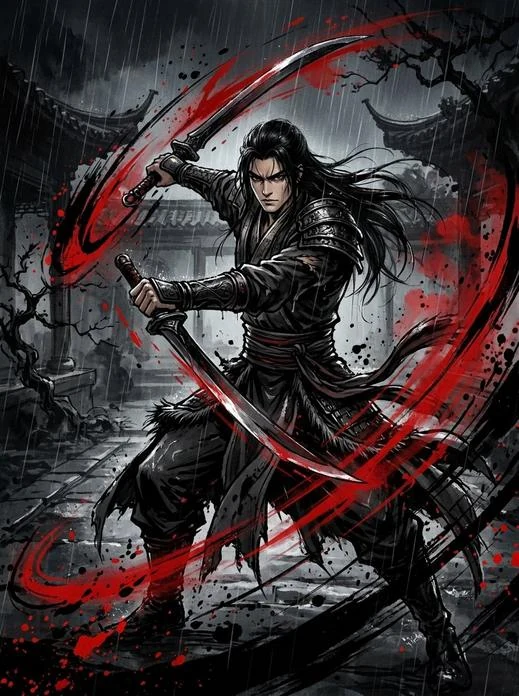
When modern action games inherit this tradition, they inherit both its physical grace and its tragic weight. The sword is never just a stat stick: it is an extension of the wielder's dao (way) and personal code. Whether a hero defends a besieged border town like Jin Yong's Guo Jing or walks alone down a rain-drenched alley like Gu Long's fatalistic assassins, wuxia asks what a person is willing to sacrifice when the law offers no justice.
⚔️ Why It Matters in Phantom Blade Zero & Where Winds Meet: How Phantom Blade Zero & Where Winds Meet Redefine Wuxia
In S-GAME's Phantom Blade Zero, producer Soulframe Liang strips away brightly colored fairy-tale tropes to recover the raw, rain-soaked grit of 1970s Hong Kong martial cinema and Gu Long's assassin thrillers. Protagonist Soul is hunted by his own organization (The Order) with only 66 days left on a failing heart—yet he still pauses in ruined villages to sever puppet-strings enslaving the innocent. Meanwhile, Where Winds Meet lets you live both sides of the wuxia coin across Ten Kingdoms China: mastering lethal martial arts while practicing everyday Jianghu professions like healing, disguises, and scholarly debate.
Primary Sources & Further Reading
- Chinese Text Project — Shiji, Youxia liezhuan ↗
- Stephen Teo — Chinese Martial Arts Cinema: The Wuxia Tradition (2009) ↗
- S-GAME — Phantom Blade Zero on Steam ↗