Meaning and historical frame
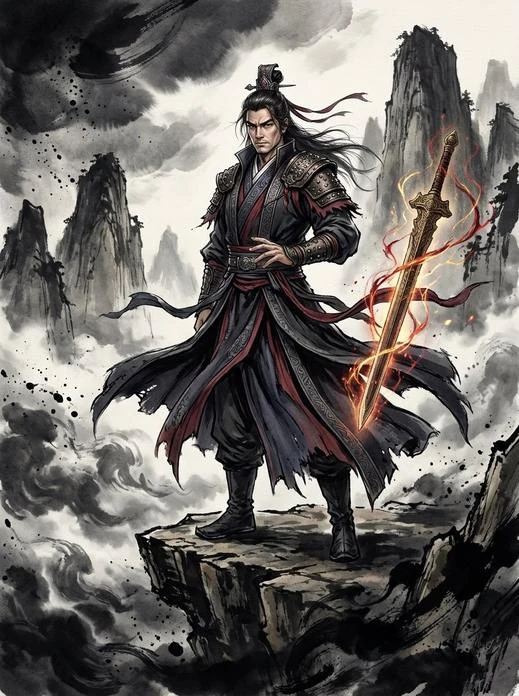
Xia can denote a person who responds to a moral obligation by taking personal risks, at times outside or against the law. Early writers did not all admire such figures. An individual's loyalty may protect someone whom an institution has neglected; it may also turn private vengeance into a dangerous rival to public judgement.
How the term travels
In the Shiji, the historian Sima Qian records and evaluates the acts of roaming knights. The very fact that such lives were given a place in the historical record does not mean their actions were praised without reservation. Later fiction turns this tension into a familiar question: what happens when keeping a promise harms people who never made it?
Read it in a scene
The player in The City at the Border may vouch for a stranger before verifying a name. That choice is an original fictional experiment in the conflict between personal surety and administrative proof, not a claim that one historical school would always decide the same way.
From Han Dynasty Assassin-Retainers to the Modern Wandering Hero
Around 100 BCE, the Grand Historian Sima Qian included a remarkable chapter in his Records of the Grand Historian (Shiji): the Biographies of the Wandering Knights (Youxia Liezhuan). Writing with personal sympathy after suffering the Emperor's punishment himself, Sima Qian praised these private men of action: 'Their words were always trustworthy, their actions always decisive, and once they gave a promise, they held their own lives cheap.'
At the same time, Legalist philosopher Han Feizi condemned the xia as dangerous subversives: 'Confucians disturb the law with their brushes; knights-errant violate prohibitions with their blades.' That tension—between moral righteousness (yi, 义) and state legality (fa, 法)—remains the beating heart of the xia archetype. A true xia does not fight for territorial conquest or official promotion; they intervene because a wrong cannot be left unanswered.
In later fiction, the xia spans a wide moral spectrum: from Jin Yong's 'great knight who serves the country and the people' (侠之大者,为国为民) to Gu Long's cynical, hard-drinking drifters who claim not to care about humanity yet die shielding a friend from an ambush.
⚔️ Why It Matters in Phantom Blade Zero & Where Winds Meet: Soul's Silent Chivalry Amidst Murderous Sha-Chi
Protagonist Soul in Phantom Blade Zero begins as a cold weapon of The Order, engineered to execute targets without question. His transformation into a true xia happens when he defies the syndicate's hierarchy, absorbs the agony of a cursed heart, and uses his lethal twin blades to sever the strings of corrupted puppet masters preying on commoners.
Primary Sources & Further Reading
- Chinese Text Project — Shiji, Youxia liezhuan ↗
- Stanford Encyclopedia of Philosophy — Confucius ↗
- S-GAME — Phantom Blade Zero on Steam ↗