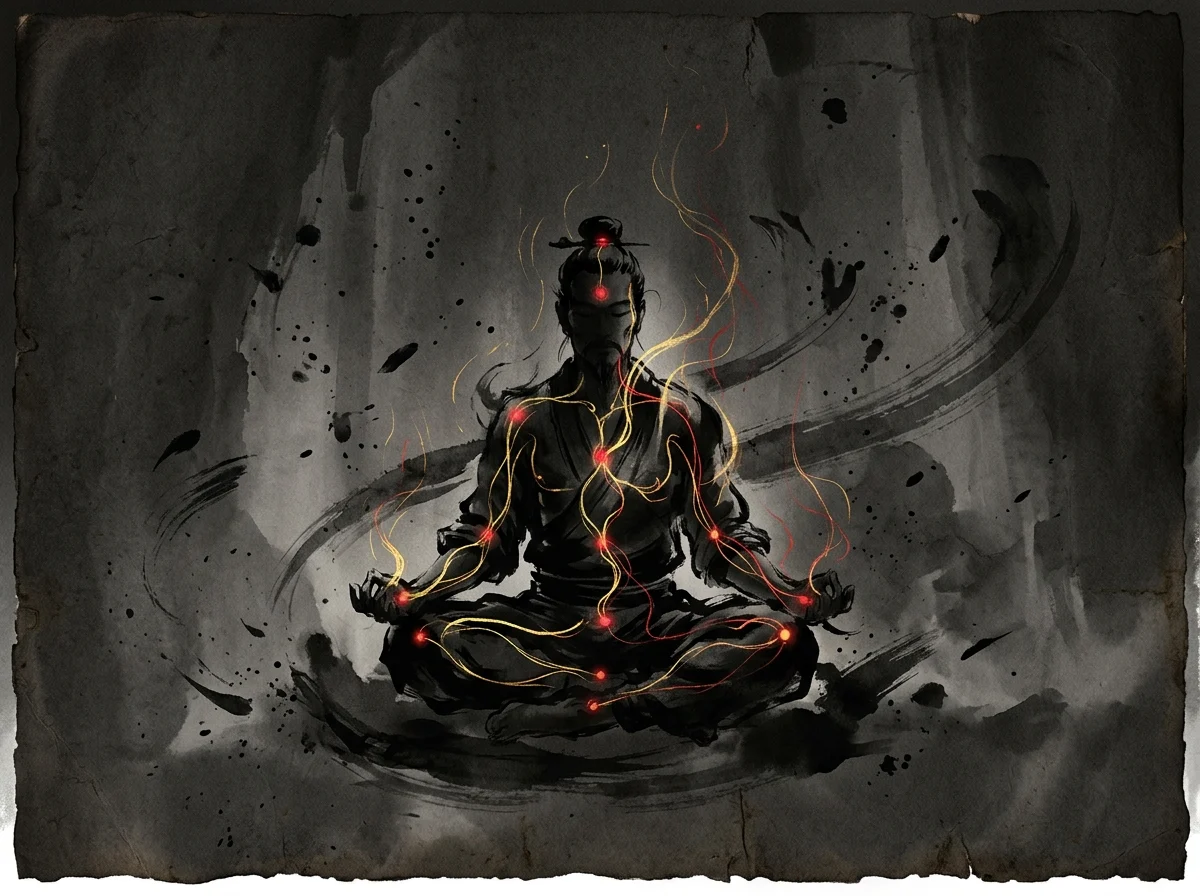
Practice and cultural meaning
Taijiquan is a living martial practice with diverse approaches and lineages. UNESCO's inscription describes shared principles and multiple forms of instruction. Its cultural history cannot be condensed into a fictional school that alone possesses mysterious power.
Regional and historical variation
The way a practitioner learns, whom they consider a teacher and how they maintain a routine are part of the practice's social reality. Films may magnify gestures to tell a story about calm authority or effortless skill. The representation has a different purpose from training documentation.
What the image suggests
When an adaptation portrays a grandmaster as physically invincible, retain the drama but do not turn the scene into a claim of scientific proof. For lineage research, prefer named communities and documentation over martial-arts ranking lists circulated without evidence.
'Four Ounces Deflect a Thousand Pounds': The Martial Science of Redirection
Recognized on UNESCO's Intangible Cultural Heritage list as a living martial and health tradition transmitted across clan and master-disciple lineages (such as Chen, Yang, Wu, Woo, and Sun styles), Taijiquan (太极拳) is often seen in modern parks as slow-motion meditation. Yet its historical and wuxia core is a sophisticated combat system built on leverage, sensitivity (Tingjin, 'listening to force'), and explosive short-range release (Fajin).
The foundational maxim of Taiji combat is Si Liang Bo Qian Jin (四两拨千斤)—'Four ounces deflect a thousand pounds.' Rather than meeting a charging warhammer head-on with brute muscle, the internal master yields along a circular tangent, unbalancing the attacker's root and borrowing their own kinetic force (Jieli Dali) to send them flying.
In wuxia lore—immortalized by Jin Yong's depiction of Wudang founder Zhang Sanfeng creating Taiji Sword and Fist on the spot by forgetting every rigid move—Taiji represents the philosophical zenith where technique dissolves into natural intuition.
⚔️ Why It Matters in Phantom Blade Zero & Where Winds Meet: Perfect Deflects, Soft Blades & Borrowing Force in Combat
When you execute a frame-perfect Deflect in Phantom Blade Zero or use the elastic whip-curves of the Soft Snake Sword to wrap around a heavy boss swing, you are practicing Yi Rou Ke Gang (softness overcoming hardness). In Where Winds Meet, Taiji redirection lets you catch incoming projectiles and hurl bears or armored guards off cliffs.