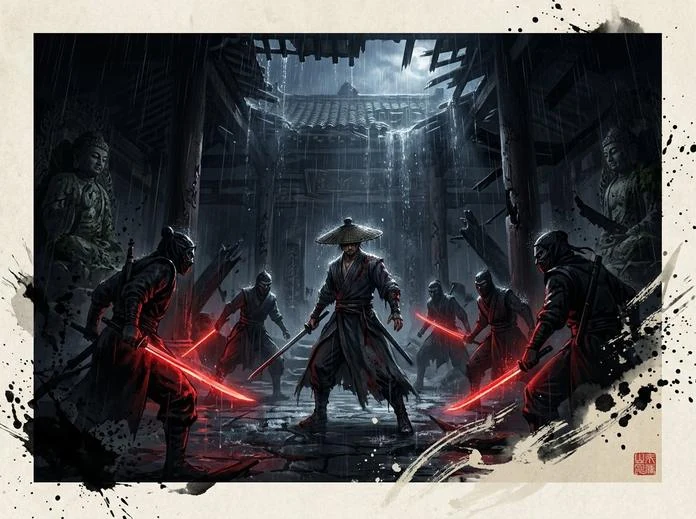
Meaning and historical frame
Martial arts cinema covers many modes of action: grounded hand-to-hand combat, swordplay fantasy, stage-derived gesture, historical spectacle and modern stunt choreography. Wuxia is also a narrative mode. A film may be full of fighting without making a knight-errant's ethics its main concern.
How the term travels
Stephen Teo traces the modern wuxia film tradition from late-1920s Shanghai cinema through its later Hong Kong and Taiwan reinventions. This history is a history of production, censorship, performers, and audience taste as well as imagery. Terms like kung fu film and wuxia film overlap but do not simply replace one another.
Read it in a scene
Compare a duel that settles a personal rivalry with a scene in which a wandering fighter must decide whether to protect a fugitive. The choreography can be similar; the narrative obligations surrounding the action give it a different meaning.
From Northern Swordplay Epics to Southern Fist-and-Steel Choreography
In English, 'kung fu movie' and 'wuxia film' are often used interchangeably, yet Hong Kong filmmakers and action choreographers draw a vivid line between them. Wuxia cinema (武侠片) centers on chivalric swordplay, historical or semi-mythic settings, sweeping garment silhouettes, and elevated lightness skills (Qinggong)—exemplified by King Hu's Come Drink with Me (1966), Chang Cheh's One-Armed Swordsman (1967), Tsui Hark's Zu Warriors and Once Upon a Time in China, and Ang Lee's Crouching Tiger, Hidden Dragon (2000).
Kung fu cinema (功夫片), popularized in the 1970s by Bruce Lee, Lau Kar-leung, Jackie Chan, Sammo Hung, and Donnie Yen, focuses on close-quarters unarmed combat or traditional southern/northern weapon sets (staff, butterfly knives, Wing Chun, Hung Gar) where every strike's physical contact, footwork pivot, and rhythmic exchange is shown in long, unblinking takes.
When these two traditions merge—combining the dark sword-and-conspiracy atmosphere of wuxia with the hyper-fast, tactile parries and bone-rattling impact of Hong Kong kung fu choreography—you get the exact kinetic language of modern Chinese action games.
⚔️ Why It Matters in Phantom Blade Zero & Where Winds Meet: Kenji Tanigaki's Choreography in Phantom Blade Zero
To achieve its signature combat feel, Phantom Blade Zero recruited legendary action director Kenji Tanigaki (collaborator of Donnie Yen on SPL, Flash Point, and Raging Fire) alongside masters from China's Emei and少林 lineages. Every multi-hit combo and Ghoststep cancel is motion-captured from real martial artists rather than keyframed like a slow Soulslike swing.
Primary Sources & Further Reading
- Stephen Teo — Chinese Martial Arts Cinema: The Wuxia Tradition (2009) ↗
- British Film Institute — Ten Great Wuxia Swordplay Films ↗
- S-GAME — Phantom Blade Zero on Steam ↗