People in transit
A wandering physician can cross boundaries that an official or warrior cannot. In fiction, a healer encounters households at their weakest, hears secrets and sometimes has to decide whose life receives scarce attention first.
Where sources fall short
Historical Chinese therapeutic traditions were diverse; a legendary healer whose touch reverses death is a literary device. Neither an invented treatment nor a character's successful recovery demonstrates medical efficacy. We therefore use care, supplies, testimony and social obligation as story mechanics without suggesting a real-world cure.
Observe a scene
Shen Ling in The City at the Border objects when characters treat a sick person as an example in their philosophical dispute. The scene makes medicine a human responsibility in the narrative; it is not patient guidance or a reconstruction of a recorded clinic.
'Never Offend the Doctor of Death Valley': Medicine and Venom as Twin Arts
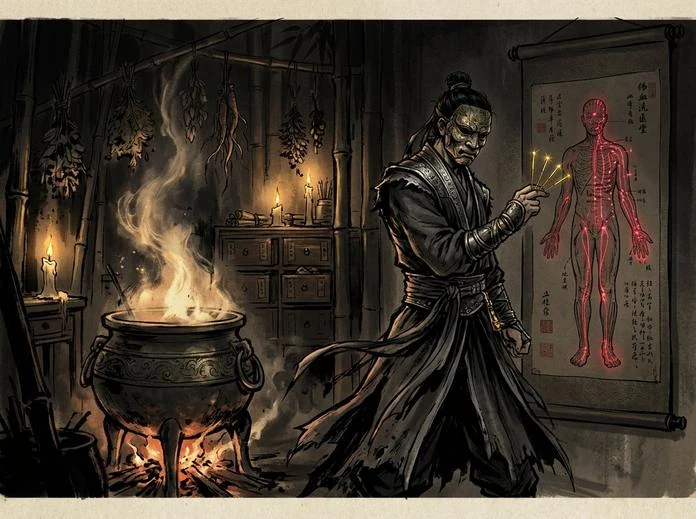
Every swordsman eventually bleeds. Because warriors in the Jianghu suffer exotic wounds—internal organ ruptures from palm strikes, severed meridians, or seven-step hemotoxins—that ordinary town apothecaries cannot treat, the Wandering Physician (Jianghu Langzhong) or reclusive 'Doctor of Death Valley' (Jianbudie / Guiyi, 鬼医) holds life-and-death leverage over the entire martial world.
In Chinese medical philosophy, 'medicine and poison share the same root' (医毒同源): the same potent aconite, centipede venom, or mineral compound that stops a heart in excess can jump-start failing meridians in micro-doses. Consequently, wuxia's greatest healers are almost never saintly clerics; they are eccentric, sharp-tongued hermits with bizarre conditions for treatment.
One physician demands that for every life they save, the patient must kill one wicked person; another refuses gold completely and only treats those who solve a riddle or survive a trial poison.
⚔️ Why It Matters in Phantom Blade Zero & Where Winds Meet: Soul's 66-Day Heart Transplant & Hollow Vale / Silver Needle Sects
Phantom Blade Zero opens with the ultimate Ghost Healer trope: after Soul's heart is pierced, a mystical physician revives him with an artificial Tainted Heart that ticks down 66 days. In Where Winds Meet, this archetype splits into two playable sects: Silver Needle (righteous fan-wielding physicians) and Hollow Vale (dark healers bound by the rule: 'For every life healed, poison must be used').