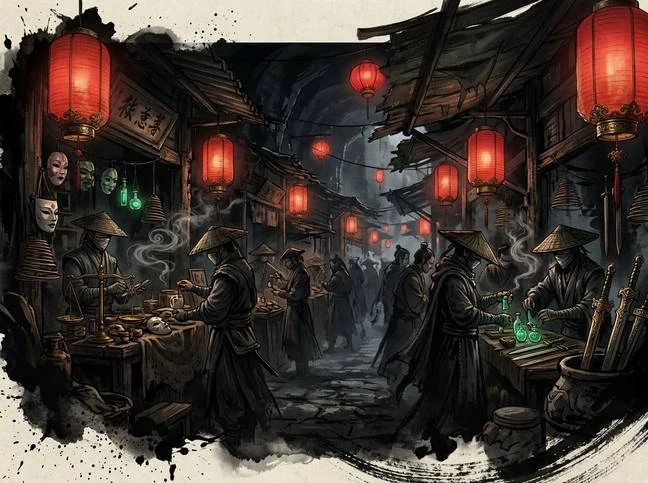
People in transit
Outlaws and secret societies occupy a contested place between social history, policing records, popular memory and sensational storytelling. A group described as criminal in one text can appear as loyal friends in another, but neither account should be accepted without context.
Where sources fall short
Later literary depictions often give communities an invented hierarchy, ritual signs and a universal code. Verification needs the group's specific date and independent evidence, not a general appeal to the mysterious jianghu. Be especially cautious about projecting modern nationalist or sectarian categories into a different century.
Observe a scene
A story gains complexity when a character's protection network also makes demands. A stranger may receive help today and be asked to hurt someone tomorrow. This tension explains the recurring allure of outlaw brotherhoods without romanticising coercion or violence.
Greenwood Strongholds, Salt Smugglers, and Shadow Syndicates
Note the pronunciation trap first: when referring to outlaws in Chinese, the characters 绿林 are pronounced Lùlín (not lǜlín), named after Green Forest Mountain where rebels gathered during the Han dynasty. Across imperial history, whenever famine, heavy taxation, or corrupt magistrates pushed peasants and soldiers off the land, they banded together into Lulin strongholds or canal/dock fraternities (Banghui, 帮会).
In wuxia literature, these organizations range from the massive Beggar's Sect (Gaibang)—whose millions of ragged members form an empire-spanning intelligence network—to river transport syndicates, salt-smuggling rings, and nocturnal assassination guilds like Gu Long's Quick-Living Forest (Kuaihuolin, 快活林) or Green Dragon Society (Qinglonghui, 青龙会).
Unlike mountain monastic sects that recruit by martial aptitude, secret societies recruit from the desperate bottom of society, binding members with elaborate initiation rituals, numbered incense halls (Xiangtang), and merciless penalties for informants.
⚔️ Why It Matters in Phantom Blade Zero & Where Winds Meet: The Order (玄机组织) & Gu Long's Assassin Syndicates
The Order in Phantom Blade Zero—along with the Four Serpent Houses guarding Mirage Estate—is directly inspired by Gu Long's monolithic shadow syndicates (Qinglonghui and Kuaihuolin). Once an executioner enters the syndicate's ledger, the only exit is a coffin—unless you carve your way to the top of Soulrend Cliff.
Primary Sources & Further Reading
- Chinese Text Project — Shiji, Youxia liezhuan ↗
- Faure and He — The Secret Society’s Secret (2016) ↗
- S-GAME — Phantom Blade Zero on Steam ↗