Body, training and fiction
Qinggong is often translated as the art of lightness. In fiction it permits leaps across rooftops, wall-running and delicate landings; film and games use camera position, performance, editing, wires and animation to make these movements feel continuous.
Claims and their limits
Historical movement skills, acrobatics and combat training do not establish that people overcame gravity in the way a martial hero appears to do. The fantasy can still convey an emotional meaning: distance from capture, temporary freedom, the confidence to cross a boundary.
Interpret the portrayal
Study where a sequence cuts. If the camera hides a takeoff and joins another view of a landing, the apparent uninterrupted flight has been constructed for the audience. Our movement viewer uses schematic drawings and never claims to document a physical qinggong technique.
Why Wuxia Heroes Do Not Fly Like Superman: The Physics of Weightless Grace
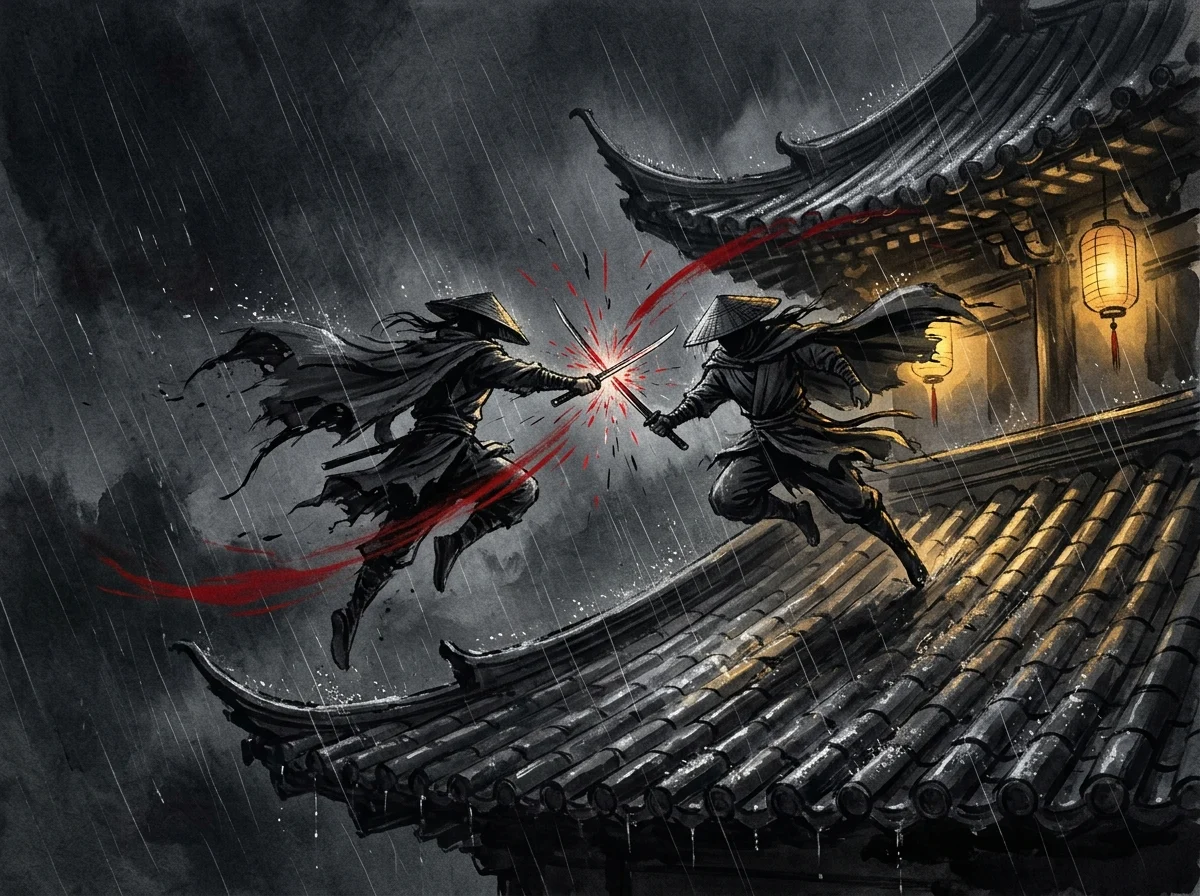
Watch the bamboo-forest duel in Crouching Tiger, Hidden Dragon or a rooftop pursuit in Phantom Blade Zero and you will notice something crucial: the fighters never hover in mid-air like superheroes or Xianxia immortals. Every leap requires a point of contact—a toe tapping a wet roof tile, a sword tip rebounding off a stone pillar, a foot skimming the surface tension of river water (Shuishangpiao, 水上漂).
Historically, traditional Chinese martial training included agility and wall-scaling exercises (zouwabi, running along walls; jumping out of weighted sand pits). In the 20th century, novelists and Hong Kong wirework choreographers elevated these drills into Qinggong (轻功): the marriage of explosive leg spring with internal Qi breath control that momentarily lightens the body's descent.
In narrative terms, Qinggong represents ultimate social freedom. Walls built by magistrates, city gates locked at curfew, and mountain chasms cannot imprison a wanderer who commands the wind.
⚔️ Why It Matters in Phantom Blade Zero & Where Winds Meet: Wall-Running, Ghoststep & Three-Stage Sky-Dash in Action
In Phantom Blade Zero, Qinggong is woven directly into combat choreography: Soul sprints vertically up wooden pillars to launch plunging aerial slashes, vaults over sweeping polearms, and chains lightning-fast Ghoststep dashes across rain-slicked rooftops. In Where Winds Meet, multi-stage Qinggong lets you bound across entire Song Dynasty skylines and glide over lakes.
Primary Sources & Further Reading
- British Film Institute — Where to Begin with King Hu ↗
- Stephen Teo — Chinese Martial Arts Cinema: The Wuxia Tradition (2009) ↗
- S-GAME — Phantom Blade Zero on Steam ↗