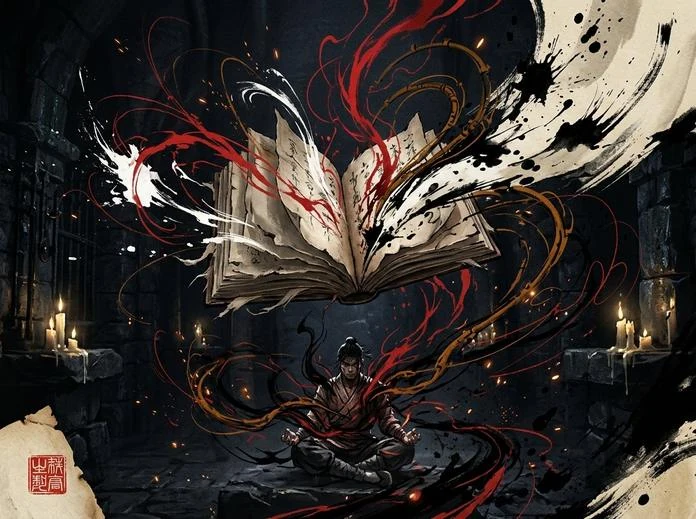
Body, training and fiction
Neigong, inner work or internal practice, is a broad label whose meanings change with school, author and period. In martial fiction, training may produce extraordinary strength or healing. Historical breathing exercises, physical cultivation and philosophical discussion belong to more varied contexts than that fictional power system suggests.
Claims and their limits
The distinction is especially important when a text invokes body channels or inner energy. Traditional models have cultural and historical importance, but their supernatural manifestations in novels are narrative devices. A description of literary inner strength is not a health recommendation.
Interpret the portrayal
Compare a film sequence of a hero restoring strength in minutes with a modern training account. The editing compresses time; sound and movement imply force; the fictional rules make a body legible on screen. None of these cinematic operations demonstrates a physiological power.
'Train the Fists Without Training the Inner Breath, and Arrive at Old Age with Nothing'
Traditional Chinese martial theory divides practice into Waijia (外家, External Methods—emphasizing explosive muscular power, speed, and physical conditioning) and Neijia (内家, Internal Methods—emphasizing structural alignment, diaphragmatic breathing, and intent guiding energy). A famous martial maxim warns: 'Lian quan bu lian gong, dao lao一场空'—if you practice external strikes without cultivating internal foundation, your strength will vanish as your body ages.
In wuxia literature, Neigong (内功) and its accompanying mental verses (Xinfa, 心法) act as the reactor core of a warrior's power. A novice with flashy sword choreography will have their blade shattered by a seated monk whose thirty years of pure Neigong turns a wooden staff—or a flicked pine needle—into armor-piercing steel.
However, forcing a high-level Neigong manual without matching mental discipline triggers the most feared catastrophe in the martial world: Zouhuo Rumo (走火入魔, Qi Deviation)—where rampaging internal heat ruptures the heart meridians and drives the practitioner into homicidal madness.
⚔️ Why It Matters in Phantom Blade Zero & Where Winds Meet: Orthodox Neigong vs. Corrupted Sha-Chi Boilers
In Phantom Blade Zero, traditional slow Neigong meditation has been superseded by dark Sha-Chi (杀气) cultivation and mechanical heart modifications. In combat, your Sha-Chi gauge acts as both your defensive guard and your offensive resource for Power Surges—if your Sha-Chi is depleted or broken by a boss's red/blue unblockable blow, you suffer a 1.2-second vulnerability lock.
Primary Sources & Further Reading
- Stanford Encyclopedia of Philosophy — Laozi ↗
- National Cancer Institute — Acupuncture evidence and safety ↗
- S-GAME — Phantom Blade Zero on Steam ↗