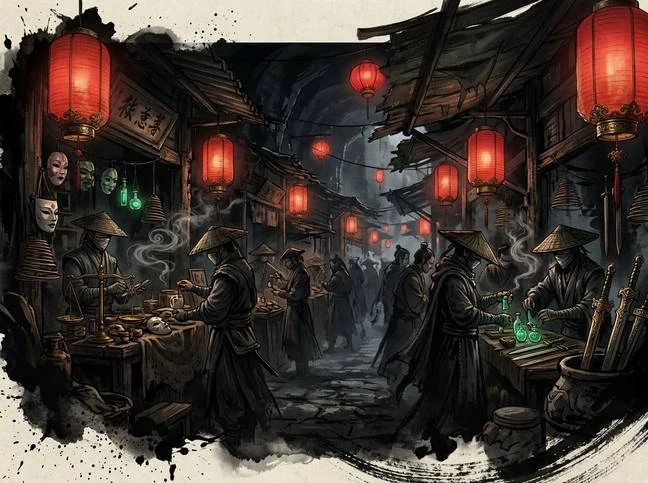
People in transit
An inn at a crossroads gives a journey a temporary household. People from unrelated places share food, lodging and rumours, while a proprietor may know more than anyone passing through. Fiction exploits this intersection to reveal mistaken identities, pursue debts and stage ambushes.
Where sources fall short
Historical lodging systems changed by dynasty, location and traveller status. A novel's inn cannot be assumed to document a specific Tang or Song establishment merely because the building looks old. Seek period-specific evidence before assigning room plans, payment customs or security arrangements.
Observe a scene
In a story, look at who controls the door and which names are written down. A public register can keep someone safe or expose them. The border-city gate in our game uses the same tension without pretending to reconstruct a known ancient inn.
The Locked-Room Thriller of the Chinese Frontier: From Dragon Inn to Black-Shop Folklore
Along historical trade arteries such as the Hexi Corridor and mountain post roads, travellers depended on fortified wayside inns (Kezhan, 客栈) to stable horses and shelter from bandits or blizzards. In wuxia storytelling, the isolated crossroads inn becomes the ultimate pressure-cooker stage—the Chinese equivalent of the Western frontier saloon mixed with an Agatha Christie locked-room mystery.
Everyone inside a rain-locked inn is wearing a mask. The smiling innkeeper wiping down the counter with a greasy rag may be a retired executioner; the scholar reading by candlelight on the second-floor balcony is watching the stairs; and the kitchen below might belong to a Heidian (黑店, 'Black Inn') that drugs travellers' wine with Mengsweat powder (Menghanyao) to rob their saddlebags.
Because wooden balconies, paper-lattice windows, and central courtyards allow vertical sightlines, an inn brawl turns architecture itself into a three-dimensional chessboard.
⚔️ Why It Matters in Phantom Blade Zero & Where Winds Meet: Ambush Architecture in Pangzhen & Where Winds Meet
The multi-tiered wooden inns and rain-swept alleys of Pangzhen in Phantom Blade Zero are designed directly around this vertical inn-brawl tradition—allowing Soul to crash through second-story lattice screens, kick lanterns into oil puddles, and ambush assassins from roof rafters.