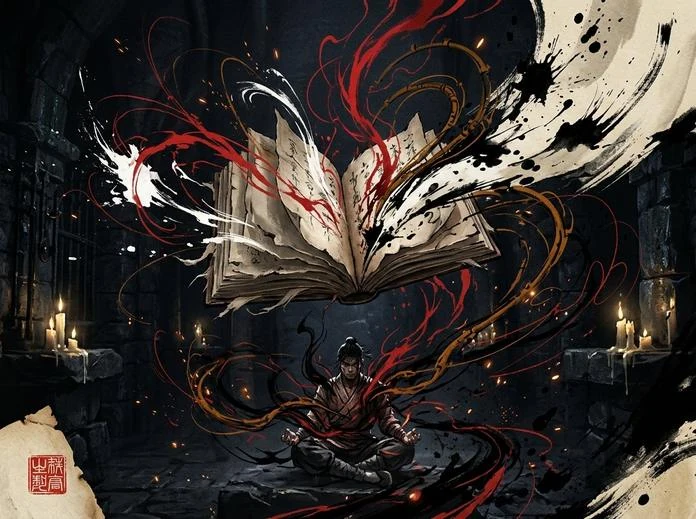
Body, training and fiction
A secret manual in wuxia concentrates knowledge into an object that can be stolen, hidden, forged or misread. Its real narrative value is control over who can learn: lineage claims become portable, while the teacher's authority may be challenged by a page.
Claims and their limits
Texts about martial practice and cultivation have existed in different periods. No single manuscript confirms the universal level systems and breakthrough mechanics of contemporary fiction. Those rules vary substantially by author and game.
Interpret the portrayal
Ask why a character seeks a manual. To gain enough power to avenge someone? To preserve a craft? To escape dependence on a master? The answer may tell you more about the moral structure of the story than the spectacular technique described inside it.
Why the Whole Jianghu Bleeds for a Handful of Silk Pages
If Western Arthurian romance quests for the Holy Grail, wuxia revolves around the Wugong Miji (武功秘籍)—the lost or forbidden martial arts manual. In Jin Yong's Condor Trilogy and The Smiling, Proud Wanderer, entire sects slaughter one another for a single volume of the Nine Yin Manual (Jiuyin Zhenjing) or the Bixie Sword Spectrum (Bixie Jianpu).
Why does a book hold such terrifying power? Because in a world without mass printing or standardized academies, a supreme master's lifetime breakthroughs—breath rhythms, meridian routing diagrams, and counter-parry timings—can vanish forever upon their death unless recorded. Authors hide these manuals inside Buddhist sutras, beneath oil paintings, or stitched inside the lining of a beggar's coat.
Most dangerously, forbidden manuals demand a price. Some contain intentionally inverted meridian diagrams planted to cause Qi Deviation in thieves; others require the practitioner to sever their own humanity—proving that the deadliest trap in the Jianghu is not the blade, but the hunger for supreme power.
⚔️ Why It Matters in Phantom Blade Zero & Where Winds Meet: Forbidden Sha-Chi Scrolls & Skill Theft in the Jianghu
In Phantom Blade Zero, forbidden Sha-Chi transformation manuals and Soul Temper blueprints turn ordinary martial artists into grotesque, multi-armed mechanical monstrosities. In our 66-Day RPG, discovering the Forbidden Crimson Scroll tests whether your Inner Qi and Erudition are high enough to master its arts without suffering heartburn backlash.
Primary Sources & Further Reading
- Stephen Teo — Chinese Martial Arts Cinema: The Wuxia Tradition (2009) ↗
- Stanford Encyclopedia of Philosophy — Laozi ↗
- S-GAME — Phantom Blade Zero on Steam ↗